
This year’s Nobel Prize in Chemistry has been awarded to the pioneers of MOFs, recognising a class of materials that has transformed how scientists think about structure, porosity and function at the molecular level.
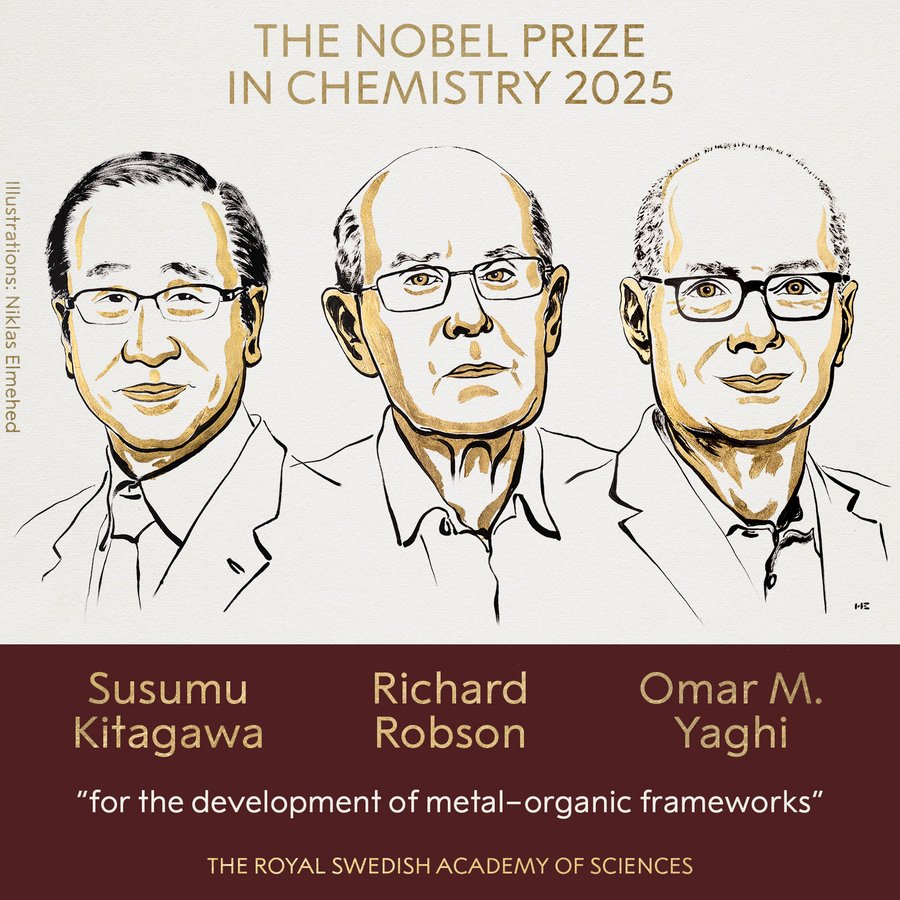
MOFs are crystalline materials built from metal nodes and organic linkers, forming highly ordered porous networks. As one of the Nobel laureates, Prof. Omar Yaghi explains in a recent interview with New Scientist, just a few grams of a MOF can have an internal surface area comparable to a football field. This extreme porosity is what makes MOFs so powerful: they can host, capture and interact with other molecules in ways that are simply not possible with conventional materials.
Prof. Yaghi is also a long-standing scientific collaborator of Prof. David Fairen-Jimenez (our CSO) at the University of Cambridge, with whom he has co-authored multiple research papers and regularly exchanges ideas. This close scientific link has been instrumental in advancing the application of MOFs beyond fundamental chemistry and into real-world technologies.
Over the past two decades, MOFs have been explored for applications ranging from carbon capture and water harvesting to catalysis, sensing and energy storage. As Yaghi describes, reticular chemistry, the discipline behind the design of MOFs, is enabling scientists to “build matter with purpose”, creating materials whose properties can be programmed at the atomic level. In his words, MOFs and related frameworks may well define the next technological age.
At Vector Bioscience Cambridge, this recognition is particularly meaningful for our mission. Our drug delivery platform is built on more than 15 years of research led by Prof. David Fairen-Jimenez at the University of Cambridge, one of the leading academic groups in the field of MOFs in healthcare applications. This work has demonstrated how MOFs can be engineered to interact with biological systems, encapsulate therapeutic molecules and control their release in a highly tunable way.
For Vector, this award is particularly timely. As we move our lead formulations towards regulated development and pre-clinical translation, the Nobel Prize reinforces the maturity and credibility of MOFs as a platform technology. What began as a fundamental materials discovery is now enabling real-world solutions in medicine, with the potential to improve how drugs are delivered, increase treatment efficacy and reduce side effects for patients.
The recognition of MOFs at the highest level of science is not just a celebration of past achievements. It is also a signal of what is still to come. We are proud to be part of this field and to contriute to turning reticular chemistry into real impact for healthcare.
You can read the full interview with Prof. Omar Yaghi in New Scientist here.